Free ATS with a careers page
Hire the right people, and see why.
Anuva scores every CV against the criteria you set, shows the evidence behind each score, and leaves every hiring decision to your team.
- 2 seats
- 2 live jobs
- 100 applications a month
- No card needed


Run hiring from one calm workspace
Post a role, get a careers page, score every application and move people through to an offer, with the whole team in the loop.


Your own careers page, live the day you sign up
Every workspace gets careers.anuva.io/yourcompany with your logo and colours. Candidates apply with a PDF CV in four short steps, and each application lands in your pipeline.
AI that does the busywork and shows its work
Anuva uses AI to draft, screen and answer questions. Your template sets every score, drafts never send on their own, and a person makes every decision.
- Screens each CV against your scoring template, with evidence per criterion
- Drafts the job description from one line, then a scoring template from it
- Finds past applicants who fit a role you just opened
- Drafts candidate emails and meeting invites for a person to approve
- Answers plain English questions about your hiring reports
- Uses the platform model, or your own OpenAI compatible key
Built for your own agents and tools
- REST API with workspace keys
- Webhooks, such as application.hired
- llms.txt on every careers site
- MCP server for Claude, ChatGPT and Cursor


From job post to first day, in one place
Write the role in one line
Describe the job in a sentence. AI drafts every section for you to edit, and can build a scoring template from the final text.
Score every application the same way
Each CV is read against your weighted criteria, by an AI model or the built in keyword scorer. Your weights and cutoff set the score.
Decide in the review queue
Shortlist or reject with J, K, S and X. Every decision asks for a written reason and lands in the audit log.
Run interviews on the tracker
Drag candidates through stages, schedule interviews, and collect scorecards against a shared rubric.
Offer, sign and onboard
Offers go through approval, out for e-signature, and into a new hire onboarding journey once accepted.
Know where hiring stands
Funnel, time to hire, source of hire and reply SLA, calculated from your pipeline with no spreadsheet.


A score you can explain to the candidate
Build a scoring template once: criteria, keywords, weights that add up to 100, and a shortlist cutoff. Every application for the role is scored against it. This is what a recruiter sees on the candidate page.
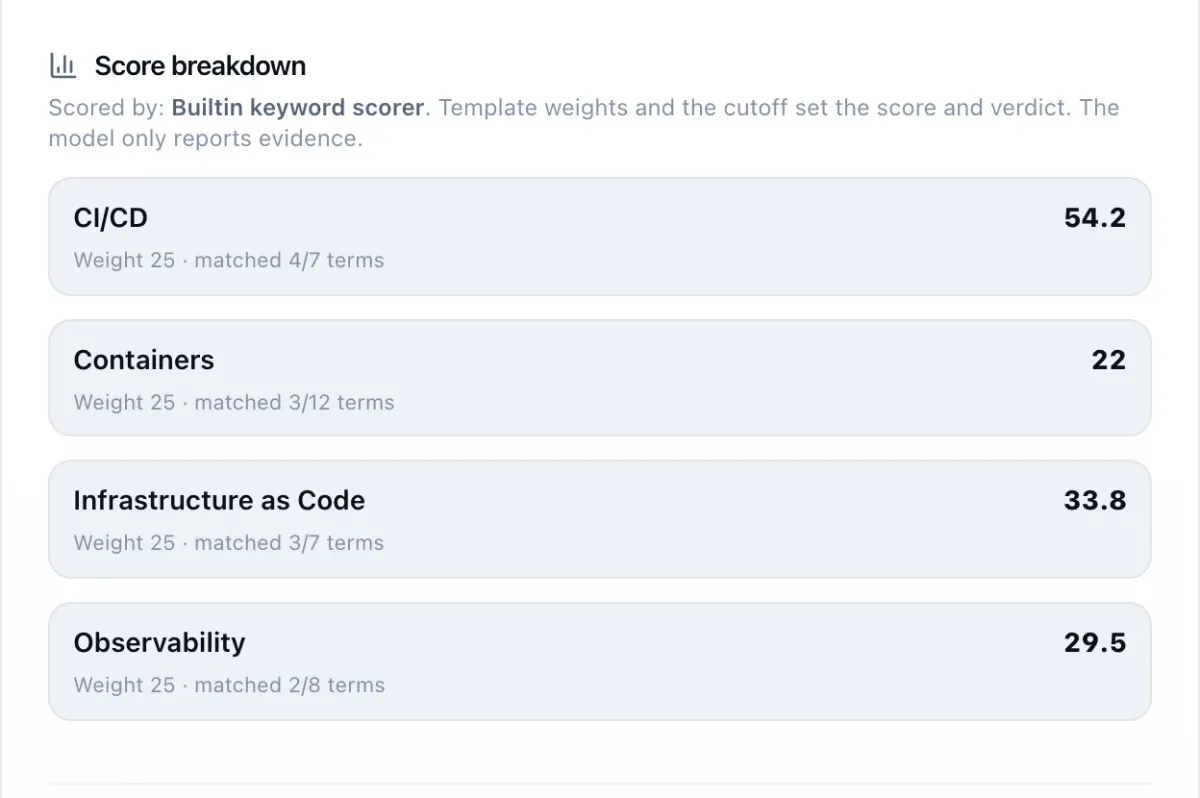
Which engine scored it
The built in keyword scorer, or an AI model if you turn it on for the role. Either way, your template weights and cutoff set the number.
Weight and evidence per criterion
Each row shows the criterion's weight and what was found, so a low score is never a mystery.
Points earned, not a black box
Disagree with a score? Override it with a written reason. The override is kept in the audit log.
AI screening is optional and off until you turn it on. The model reports evidence, your template sets the score, and CVs it cannot read are set aside for a person.How resume screening works
A pipeline your team can keep up with
The tracker shows every candidate by stage with their score, time in stage and owner. Drag a card to move it, or select several and move them together. Moving someone to rejected asks for a reason.
Interview kits give each interviewer the same questions and rubric. You can require a scorecard before anyone drafts an offer.
Pipeline and interviews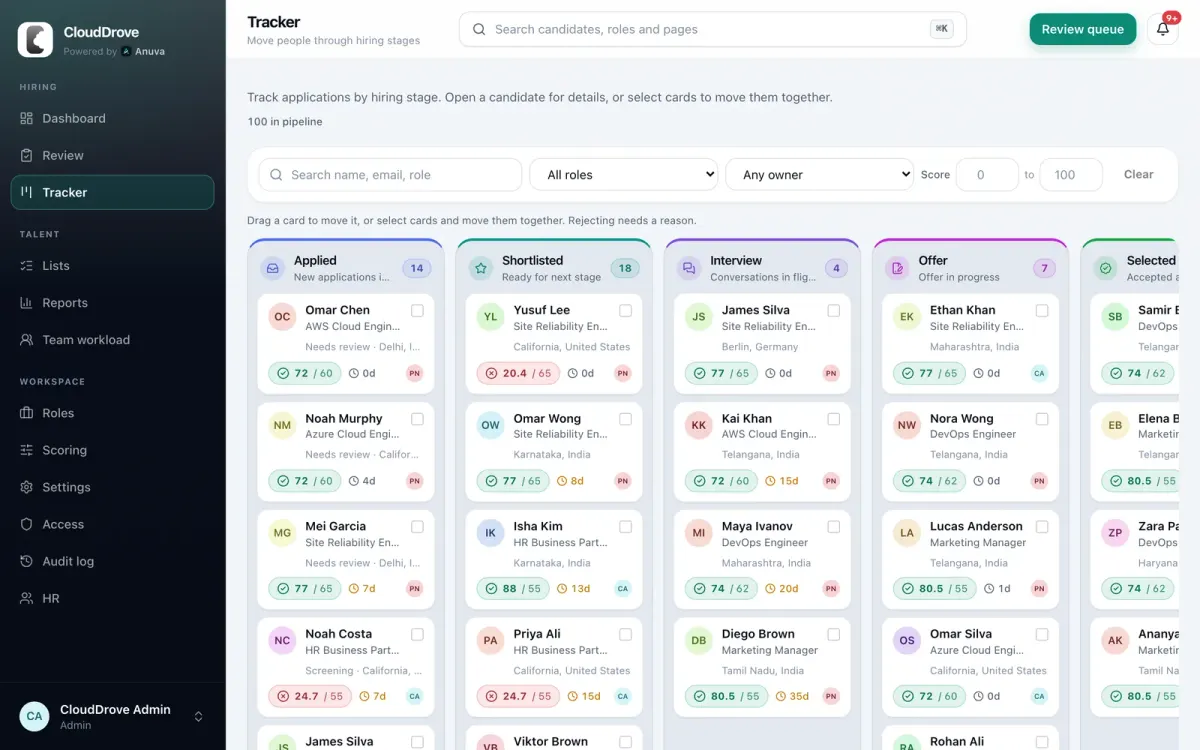

Reports that answer the questions you get asked
Funnel, median time to hire, time in stage, source of hire, reply SLA and decision quality are calculated from your pipeline, for one role or all of them. Fairness reports check selection rates by group against the four-fifths rule and alert you without blocking anything.
Reports and fairness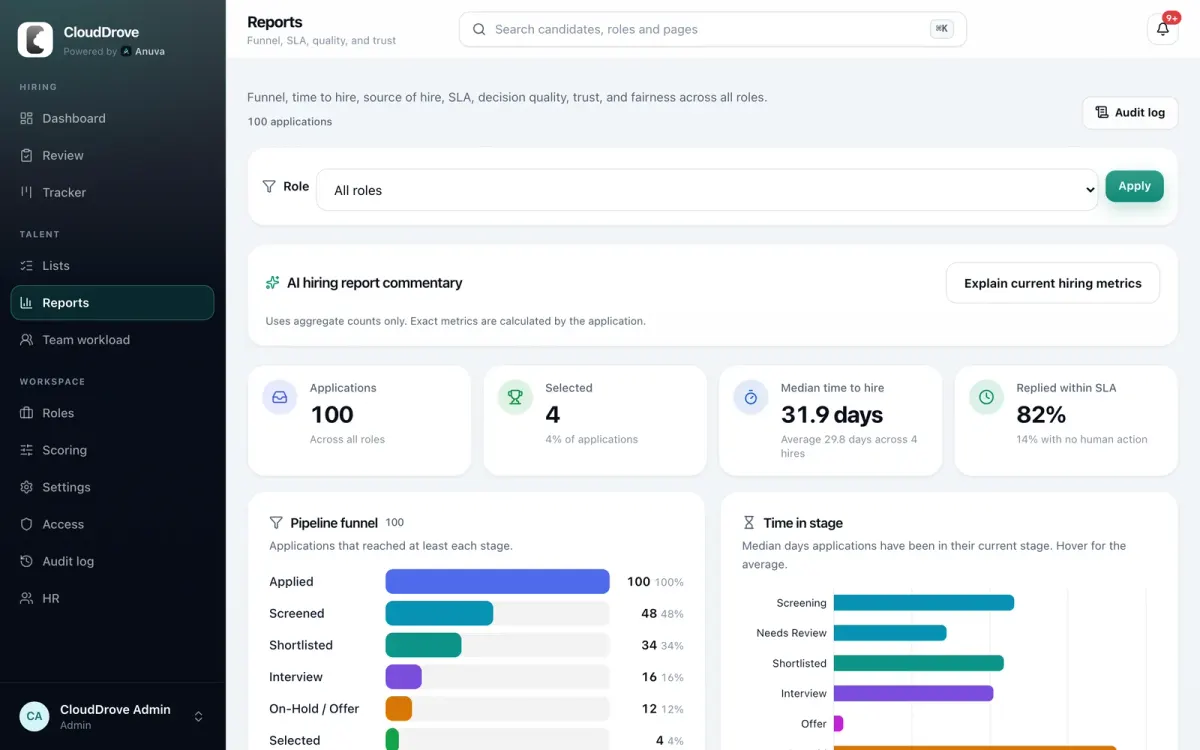

A careers page the day you sign up
Every company on Anuva gets a careers page at careers.anuva.io/yourcompany, free, with your logo and colours. Candidates search open roles, read the job, upload a PDF CV and answer your questions, then track their application.
- Share any job on LinkedIn and the post shows a rich preview card with the role and your brand.
- Live roles publish Google for Jobs markup.
- On Growth and Enterprise you can use your own domain instead.
Anuva compared with spreadsheets and email
If this is how you hire today, here is what changes.
| What you need | Spreadsheets and email | Anuva |
|---|---|---|
| Every applicant is scored against the same written criteria | Depends on who opens the CV | Weighted template with a cutoff, applied to every application |
| You can see why someone scored the way they did | No | Per-criterion breakdown with matched terms or model evidence |
| Rejections have a recorded reason | Rarely | A written reason is required, and it is audited |
| Candidates hear back | When someone remembers | Status emails on stage changes, SLA alerts when replies slip |
| Time to hire and source of hire | Built by hand, if at all | Live in Reports, per role or across all roles |
| Who can see salary and CVs | Anyone with the sheet | Roles and custom permission sets, enforced by the API |
Built for the security review
- $0
Free plan, no card needed
2 seats, 2 live jobs and 100 applications a month, with a careers page.
- 1
Database for each workspace
New workspaces get a dedicated Postgres database, with row level security inside it.
An audit log with origin
Overrides, stage moves, settings changes and exports, with place, network and device.
Every score explained
Criteria, weights and the evidence behind each number sit on the candidate page.
No raw CV text in the database
CV files sit in encrypted object storage. Only structured fields are stored.
Privacy tools built in
Candidate privacy notices, retention that deletes CVs on schedule, and access and erasure requests.
Prices on the page
Compare plansFree
$0 / month
2 seats, 2 live roles
Starter
$49 / month
10 seats, 10 live roles
Growth
$199 / month
25 seats, 25 live roles
Enterprise
Custom
Custom seats and meters
Common questions
Something else? Write to hello@anuva.io and a person will answer.
What is Anuva?
Anuva is an applicant tracking system. It gives your company a careers page, scores every application against criteria you set, and runs the pipeline from review to interviews, offers and onboarding, with a person making each decision.
Is there a free applicant tracking system plan?
Yes. The Free plan costs $0 a month with no card needed and includes 2 seats, 2 live jobs, 100 applications a month, a careers page at careers.anuva.io/yourcompany and a one-time AI trial (5 AI job descriptions, 10 AI scoring drafts and AI screening for the first 10 applicants of each role).
Is Anuva a good ATS for startups?
It is built for founders and small HR teams that want a real pipeline instead of an inbox full of CVs. Start on Free, then move to Starter at ₹1,999 ($49) a month or Growth at ₹7,999 ($199) a month when you hire for more roles. One price per workspace, not per recruiter.
Does Anuva work for hiring teams in India?
Yes. Offers can be written in INR or any other currency, source of hire reports cover channels such as LinkedIn and Naukri, and the careers page works on phones. Plans are priced in INR with a GST invoice for Indian companies, and in US dollars for everyone else.
How is Anuva different from a spreadsheet?
Every candidate has a stage, an owner and a score with the reasons behind it. Reply promises are tracked, every decision needs a reason, and reports show time to hire and source of hire without manual work.
See Anuva on your own hiring
Book a demo and bring a role you are hiring for. We will walk through screening, the pipeline and reports with it, and answer security questions on the same call.
or email hello@anuva.io


